Showing posts with label North Korea. Show all posts

Friday, 9 September 2011

Korean War Museum

2009 09 17 – Day 83 – Dandong

One of the few 'sights' of Dandong, this Korean War museum has an impressive title that simultaneously demonstrates both the descriptive nature of Chinese and the 'editorial line' of the curators. It's official name translates as:
'The Museum to Commemorate the War to Resist American Aggression and Aid Korea.'
A 53-meter cenotaph commemorates the 1953 cessation of conflict and the 115,000-400,000 (depending on who's counting) Chinese conscripts and volunteers who died executing Mao's "human wave" strategy, designed to overwhelm superior firepower and weaponry with sheer numbers.
For a small entrance fee you can climb the inside of the cenotaph for grand views of the arrayed hardware of war;
and, were it not for the smog, I'm sure there'd be spectacular views across the city and into North Korea, but sadly I couldn't see much further than the main museum buildings less than 100m away.
More hardware welcomes visitors,
followed by Mao Zedong and Kim Il Sung, the first among equals from the Chinese and North Korean sides, celebrating their hard won 'victory' with their comrades.
Flanking the statue are two short, two-storey, introductory texts: a "Joint Declaration of Democratic Parties in China" announcing the US/allied intention to "not only destroy [North Korea], but also annex Korea, invade China, rule Asia, even conquer the whole world." (4th November 1950); and an "Order of the Formation of the Chinese People Volunteers" declaring the righteous nature of their cause assisting their Korean neighbours in resisting the imperial aggressors (8th October 1950).

Somewhat surprisingly, the museum entrance was free which was a welcome change from my Chinese tourism experience so far and especially generous considering the scale and scope of he exhibition.
The range of artefacts on display was impressive and well presented including:
Chinese weaponry;
and standard kit;
US kit;

dynamic summaries of offensives and troop movements;

a mini reconstruction of a North Korean/Chinese tunnel base;
propaganda espousing the pointlessness of war and the joys home, dropped to break US/allied moral, and poignant letters home from GIs;
An informative section on the nascent Chinese airforce and an impressively arranged, painted and lit 360 degree diorama of a battlefield;
it was actually quite difficult to identify the join between three-dimensional models and painted backdrop.
Exiting the grounds of the museum gave you a closer encounter with the field of hardware.

Despite its impressive array of artefacts, information boards and well laid out displays, the museum was somehow a frustrating blend of the positive and negative possibilities of museums. As far as a museums responsibility to deliver a sense of how things were at a time in history, it was a huge success, with ample artefacts and plentiful pictures well edited, arranged and curated. However, as far as a museum might be expected to deliver an objective reflection on past events, the politics dictating the editorial of the information boards was perhaps more evident in what was not said rather than what was. For the most part, the boards offered an exhaustive catalogue of events, delivered without much more imagination than a list of names, dates, times and quantities (or whichever appropriate combination). It took me until I was about half way round to realise that of all the many information boards I'd read, not one had mentioned a US/Allied victory and while there were plentiful reference to (dubiously large) numbers of enemy killed or captured at each battlefield, there was not even one mention of a single Chinese or North Korean casualty or strategic loss. Campaigns were always presented as victorious, with no explanation as to why there were multiple 'successful' campaigns, at different times, for the same territory, no mention of the (presumably) enforced retreat between the different 'successful' offensives.
Throughout, the US/S.Korean/Allied forces are labelled as imperialist aggressors and oppressors while the Chinese/North Koreans are labelled as valiant volunteers and courageous defenders of freedom.
The walk back to my hotel gave me plenty of time to reflect on what effect that kind of one-sided account would have on Chinese visitors to the museum.... no wonder it was free entry!

Sunday, 4 September 2011

The Great Wall and North Korea

2009 09 17 – Day 83 – Dandong


Not far from Dandong is the most northern and eastern section of The Great Wall. Dandong is about sixteen hours by train from Beijing and I found it mind boggling to reflect on the size of The Great Wall given that it runs not only to Beijing, but further west at least another twenty four hours of train journey! The question arises – Does the word 'Great' do it justice?

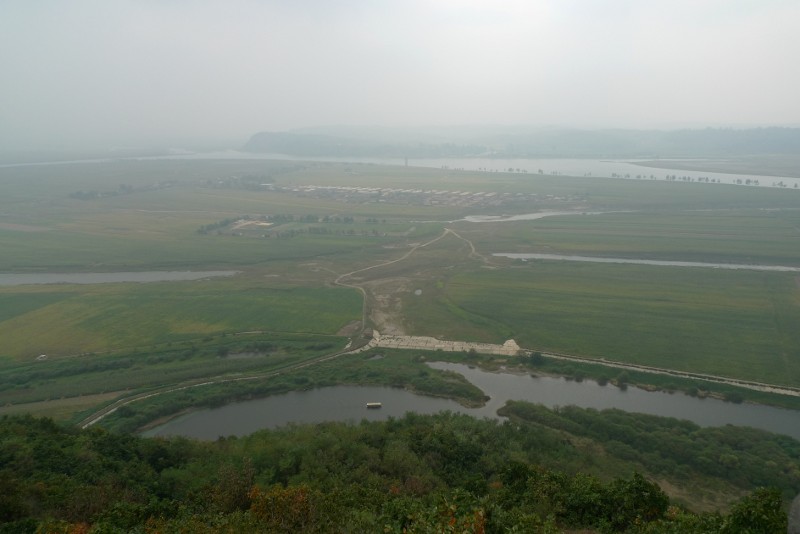
Rising quickly, The Wall provides a Great vantage point to survey the juncture of China and North Korea. The hills of the former falling to meet the flat farmlands of the latter, separated by the silver ribbon of the Yalu River.

The only North Korean settlement in sight was a small farming village and, at the crest of the wall, a local entrepreneur provided an old, possibly military, telescope to satisfy the inevitable curiosity of tourists. For a small fee of course. Though it felt a little wrong, I couldn't resist a peek and paid the 3 RMB to spy on the unsuspecting villagers below. It felt like I was looking back in time. The way the people dressed, the tools they used, no evidence of basic modern improvements like road surfacing or telegraph or power lines. I tried to capture an image using the telescope to assist my camera and though I didn't manage to photograph exactly what I'd just been looking at, I managed to get something:

Before I could take any more shots, the telescope owner spotted what I was doing and made a noisy display of disapproval, shooing me off his prize asset.

Sometimes even the ambitious engineers of The Great Wall can't improve on nature's natural barriers:


Walking back around the base of the hill takes you literally within a stones throw of North Korea. About as close as you can get without actually trying to cross the border.

I don't know what the sign says, but I could swim it from here.

Teasing those who might be tempted to try and cross, this boats bottom was so holy it would be about as buoyant as a colander!


At busier times, these small boats would be offering tourists a slightly closer view of their neighbours, but without some pretty good yarns to go with it, I doubt if the few feet of proximity gained would be worth it.


Dark by Day, Light by Night

2009 09 16 – Day 82 – Dandong

With smog strangling the strength of the sun, it seemed like Dandong's days might never be described as bright and twilight slid effortlessly into night.
On came the lights and with them the city seemed to come to life, becoming simultaneously more lively and cheery.

The China-North Korea Friendship Bridge became more friendly, though gaudy, with its lights gently cycling through the primary colours.

A nightly, musically enhanced fountain show provided a pleasant backdrop:


But it wasn't clear if the purpose was to entertain the (few) tourists, the locals or to show off to the North Koreans across the river.
There were plenty of locals about, but most didn't pay much attention to the fountains, entertaining themselves, often in group activities like this tai chi group:

Tuesday, 19 April 2011

Around Dandong

2009 09 16 – Day 82 – Dandong

After a comfortable overnight train from Chengde, I arrived in the industrial city of Dandong which sits on the Yalu River that defines the border with North Korea.
The sun seemed to be fighting a losing battle with the smog.

Not particularly keen to spend more than the one night necessary to see all there was to see, I managed to buy a train ticket away for the next evening and then set about finding a place to stay. Happily, that didn't prove too difficult, as Lonely Planet's information proved accurate.
It was quickly becoming clear that Dandong was far less prepared for international travellers than Beijing or a more obvious tourist destination like Chengde. This was emphasised when, as I was heading out to explore, I accidentally broke my key in the lock of the door to my room! I found a cleaner and showed them the problem, neither of us understanding a word the other was saying. After that, all I could do was wait as a succession of people came to try their hand at fixing the problem. Had I been in an English speaking hotel, I would have felt comfortable leaving them to fix the door while I went out, but limited by our mutual lack of language, I wanted to do more to be sure my stuff was secure. Eventually, thankfully, the bit of key was extracted and I was able to move my stuff to a different room and head out to explore. The staff were very pleasant throughout the whole incident. I had worried there would be shouting and finger pointing and demands of money, but there was none of that and they even returned my full deposit when I checked out the next day.
Despite the setback in time and the blanket of smog enveloping the city, there was still light enough to explore:
The Yalu River side
The North Korean side of the river is visible in the background. There is supposedly a city on the other side, but the horizon was mostly a tree line, with the occasional building just about discernible. Maybe on a clear day there are more buildings visible... if they have clear days.
This a tourism jetty. You can take tours along the river and close to the North Korean side. I gave it a miss.
Behind are the two bridges on the river. One of the bridges only extends part way into the river as it was not repaired after the Korean War. The complete, China-North Korea Friendship Bridge, carries rail and road traffic between the two countries. I saw plenty of trucks crossing from China into North Korea, but no other type of vehicle and nothing coming back the other way.

The next day, I got a few other views of the city
Above are some of the few older buildings in the central area, before Dandong, like most Chinese cities it seems, became more vertically inclined.

There is quite a Korean feeling about parts of the centre and certainly plenty of Korean influence in the places to eat.
Some shops more obviously welcomed Koreans than others.