Showing posts with label 2009 07. Show all posts

Friday, 14 May 2010

Ruslan's Palace

2009 07-08 - Samarkand

Ruslan, as I mentioned, seemed to have a lifestyle that was a bit above your average train carriage guard and his large and well built home was evidence of that. I was particularly interested in the generally minimalist nature of the place and how the large bright spaces with choice details made the place feel modern, and yet certain elements we take for granted in the West were far from my understanding of modern. It definitely reflected a different way of life to where I come from.

I include this photo primarily for the evidence at the right side of the almost floor to ceiling pile of soft mattresses available for guests to recline on at social functions... presumably held here:

The main 'lounge' and my bedroom for the night. Ruslan & his youngest sister have rooms off this one.


Ruslan's mum lives in this 'wing'. The main part of the house is on the left.


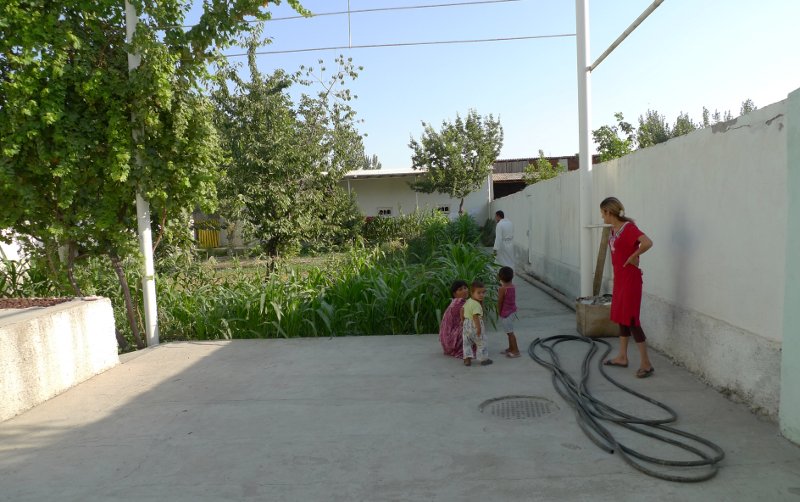
A continuation of the concrete with a herb, fruit and veg garden behind. Anywhere on the concrete terrace could become a table with the placement of a matt and there always seemed to be some invaluable shade provided by one wall or another throughout the day and so it was the main social space.


Outhouse at the end of the garden houses, amongst other things, the pit toilet – simply a wooden floored room with a floorboard taken out for the hole. I was surprised at how clean it felt as I've seen plenty of worse setups with ceramics and piped water. With no door and a window opening, there was plenty of air flowing through making it near odour free.... but I never did quite understand how you were to know if someone else was already using it without them whistling, singing or talking or something! Fortunately I never had the awkward situation of walking in on anyone, or anyone walking in on me!


The bucket shower cubicle. I really enjoyed this! When the weather is so hot, an outdoor bucket wash is great!

Ruslan's Clan

2009 07-08 - Samarkand


A small cross-section of Ruslan's clan welcomed me with tasty lamb stew Uzbek style: Ruslan, his two kids and one each of wife, aunt, sister, family friend, mother and brother. Behind the camera are two other brothers - I lost count of how many brothers, sisters, aunts and uncles Ruslan has, but certainly I met many and it seemed like most of the village was in some way related. After we'd polished off the food, Ruslan pointed out that it was a bit late for him to drive to my hotel and back to return me, especially since he'd had a few vodkas! So why don't I stay the night? Accepting his kind offer meant there was enough time for us to head out into the village for a few drinks with friends.


Sharing a fabulous traditional Uzbek lamb and rice based meal the next day with Ruslan and some of his closest friends (L to R): Aman a Turkmen walnut trader; Muhammed a champion billiards player, owner of champion fighting dog and general wheeler dealer; and Uzbekistan's champion kickboxer whose name I forget but I won't forget that his hands seemed to be developing into permanent fists!


Ruslan's little princess and imp – extremely cute and keen to help clearing the dishes after a meal!

Thursday, 13 May 2010

Ruslan

2009 07-08 - Samarkand

Ruslan, who I met on the Aralsk to Tashkent train, is quite unlike anyone I've met before.
Ruslan is a force of nature. Born with both feet on the accelerator, a cigarette at his lips, a steering wheel in one hand and bottle of vodka in the other, Ruslan knows how to live life to the full, in the moment, riding on instinct.

An irresistible mix of charisma, charm, positivity and action, Ruslan is a man for the lads, a man for the ladies, a central figure in his community and, in his own particular way, a family man and a humble and respectful muslim.
We shared almost no language other than the limited vocabulary in my pocket Russian phrasebook and yet we got on like a house on fire. This seemed to be his affect on most people, language barrier or not. At a brief pit-stop at my hotel, Ruslan got chatting to some Spaniards about to continue on their way from Madrid on the Mongol Rally. It took less than 5 mins of broken English conversation for Ruslan to obtain the Spaniards' phone numbers and a cautious promise of a place to stay if he ever made it to Madrid!
Ruslan's official job, as far as I understood, is a train carriage guard, though I'm pretty sure he has a few projects on the side because, from what I saw of his life while entertaining me, he's better off than I imagine the average train guard to be.... He's well connected, laughing off concerns of being stopped at the police road checks, and knows everyone in his area. Whether cruising through the village at walking pace to Russian gangsta rap, or weaving through the traffic on the intercity roads with Armin Van Buuren's State of Trance setting the pace, Ruslan always had time to say hi to his friends and extensive family. On numerous occasions he'd pull over, as would the other person if they were also driving , get out, say a brief hello, find out the latest news, and then we'd be on our way.
There was never a dull moment with Ruslan.

Uzbek Roads

2009 07-08 - Uzbekistan


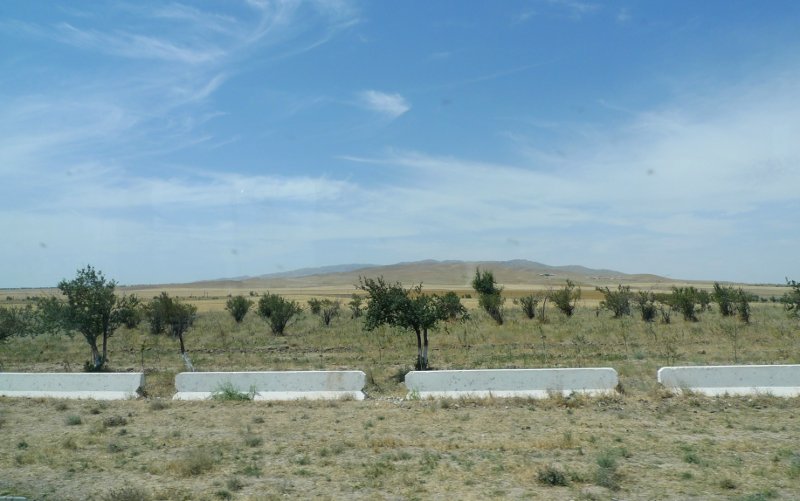
Only slightly less organised than their currency situation, though reasonably well maintained, Uzbek roads have their own rules. For the most part people travel in the same direction on one side of the road. - usually the right. How big one side of the road is is dependent on the number of vehicles travelling in each direction, how aggressive everyone is driving and if those in front hear the horns of those wishing to squeeze past! In the cities I did sometimes see some road markings, but they were only treated as surface decoration or as if someone had accidentally spilled some white paint on the road... in very straight, evenly spaced lines. On intercity roads, donkey carts are more frequently encountered as the roads run through the widespread rural areas. These 'vehicles' follow their own rules and just need to be avoided by the rest of the traffic. On these roads the side-of-the-road situation is simplified a bit as they usually have concrete barriers running down the middle, which limits the number of cars, side-by-side across the roughly two lane highway, to three. These central concrete barriers have breaks in them every now and then, near-ish to side-roads, which are usually dirt tracks at right angles to the main road, but as they don't align and there are no feeder lanes or traffic lights, a couple of wonderful safety enhancing scenarios are created when trying to turn left (assuming you'd been driving on the right like most folk):
Either
1. overshoot your exit, manouvre into the fast lane before breaking hard, possibly to a standstill, to facilitate a U-turn across to the other side before driving to your exit
OR
2. Switch lanes through the gap that precedes your exit and drive to it against the flow of traffic.
Either option is entirely valid. This 'system' functions is because most people, other than bus drivers, don't drive that fast, the roads are not too crowded and everyone uses their horn liberally to announce their imminent attempt to overtake. I suppose the fairly regular and permanent police check points also help to sort out the chaos with their short one lane per direction funnel approximately every 30-50km. Other than the buses, lorries and donkey carts, the majority of vehicles on the road are old Ladas or new, Uzbek constructed, minivan Daewoos.

Uzbek Money

2009 07-08 - Uzbekistan

The Uzbekistan currency is the Som. For the first few countries on my route, I had hoped to arrive with some local currency already in my pocket to provide flexibility, but you can't get Uzbek Soms at money changers in the UK. In fact, you can't get Kazak Tenge in the UK either, but my passage through Kazakhstan had been relatively painless, helped in no small part by their fully functional NCR cash machines. No such luxury in Uzbekistan, whose capital city, Tashkent, a city of at least 2 million people, only has cash machines in the really high end hotels, but, as I discovered on my first night, none of the machines work!
In both Uzbekistan and Kazakhstan, Dollars and Rubles are accepted and easily exchanged, but I didnt' have much of either to minimise how much I could lose or have stolen. On entry and exit of Uzbekistan, you must declare, amongst other things, the value of US Dollars and Russian Rubles in your possession. The necessity of this declaration is no doubt due to the thriving currency black market in Uzbekistan... most likely just one of many black markets. The government is presumably to blame for the farce, because it's official exchange rate is US$1 = 1500 Som while any Joe on the street corner can give you a rate of US$1 = 1800 Som... not an insignificant difference and the street price must still be some way off the 'real' rate for it to be worth the risk to 'Joe' of being reprimanded. It was my understanding that, on exiting Uzbekistan, I would have to present receipts of money transactions during my stay and so, as I was there only a short time and not wanting to run into 'complications' with Uzbek border officials, I found a bank as soon as I could after arriving in Samarkand. Though they didn't accept travelers cheques, they did accept a VISA withdrawal, which was just as well because I was running short of options that didn't involve pawning possessions... Of course the VISA withdrawal carried a fee from the bank and had to be in US Dollars which I would then have to change into Soms at the government rate. When I eventually had my fists full of Soms, they really were full! Not because I was rich, expected a spending spree and changed loads of money, but because the biggest Uzbek note is 1000.... and 1000 Soms buys you....
a 2 Litre bottle of water.
The result is that I had to re-evaluate my approach to carrying money as I now I had two big slabs!

On the bus to Samarkand, while we waited to depart Tashkent, a man across the isle from me had stashed literally bricks of cash in plastic carrier bags and now I understood why.
Every hotel desk has an electronic note counting machine, not that they really need it since everyone in Uzbekistan can count large stacks of cash at lightning speed!

Saturday, 24 April 2010

Bus to Samarkand

2009 07 31 – Day 35 - Tashkent to Samarkand


The bus station is just a big tarmac space with numerous buses strewn across it.
Fortunately for me, I've already paid (probably far too much) for this bus journey through Sundowners, so the hotel driver guides me through the chaos to a bus shortly to depart for Samarkand. He pays someone who seems to be connected to the bus, we stow my main bag and then they direct me to a front seat, uprooting some poor local passenger in the process. I protest that it's ok, I can sit further back, but my protests are only met with stronger assertions that I should sit in this front seat. I accept my nominal VIP status and sit where instructed.
Across the isle from me a man stashes his bricks of money in non-descript plastic bags.
Now I can catch my breath and look around a little and observe the organised chaos outside, it quickly becomes clear that these buses are run like big shared private taxis. There are a few young lads working for this bus, harrying anyone who gets close-ish to the bus to buy a ticket and climb on board. One woman was almost dragged to the bus before she managed to free herself and her shopping bags and go around the bus as she'd originally intended!


When the bus is half or two-thirds full, the driver starts the engine and rides the clutch, revving the engine – making it clear to all those within eyesight, earshot and those stood 2cm in front of the windscreen that were about to go, so get on now or get out of the way or you'll be left behind or run over!


I'm joined in my VIP front row by this chunky fellow who wedges me in securely enough that I'm not so concerned about the lack of seatbelt. An exchange of sounds reveals that we don't speak each others language, but it does result in a mutual showing of passports... English characters in his reveal that he's from Internal Affairs. After I decline his kind, and presumably illegal (?), offering of hash, he takes a big wad in his mouth and spends much of the journey chewing on it and leaning over me to spit, with varying degrees of accuracy, out of the windowless door.


Uzbek roads are good enough to allow our battered bus to be the fastest thing on the road. Not because everything goes really slow, but because our driver is fearless and seems confident that other road traffic, including the donkey carts, would be well advised to stay out of our way! He does his best to dish out such useful advice to those we're about to pass with energetic and liberal use of his horn.
I don't know if I should be unsettled by the resin-filled head-sized hole in the windscreen in front of me. The multiple screen-wide cracks radiating from the wound don't fill me with confidence that the thing will hold together the entire four hour journey.
During the course of the journey we pass through at least eight road blocks. These are not because of some extraordinary security situation, but just part of the everyday monitoring of the movement of people from one region to another. Traffic is filtered through a speed-bumped single lane 50 metre stretch next to a guard building. While negotiating this bottleneck, guards have the opportunity to ask vehicle drivers to pull over to have their vehilce inspected. At each stop, one of the young lads managing money and passengers jumps out with a piece of paper that he gets stamped before we can go on our way. The whole process if very quick and we almost don't stop. Thankfully our bus was never chosen to be inspected.


Uzbekistan seems to have a fair bit more green than Kazakhstan.


A short stop enables passengers to buy apples from this orchard, while the bus crew fill the vehicle's water tank from the irrigation ditch. Some of the poor bedraggled creatures who emerge from the bowels of the bus make me realise how fortunate I am with my well airated VIP seat by the window-less door.


Half way through the journey, some locals, standing in the isle in anticipation of their stop, try to strike up conversation... the problem is their limited English and my lack of Russian. They do however persuade me to take a phone from one of them and talk to some guy they know who can speak English... It was a very strange conversation - he didn't know who I was, I didn't know who he was or where he was, we couldn't see each other, we'd never met and the reception wasn't great so half the time we couldn't even hear each other! Just before his stop, a teenager invited me to see his village... I have to say I was curious, but we hadn't even spoken to each other before that and the Uzbek authorities require you to register in each place you stay... in hotels that's a straight forward process, but for private residences, I'm not so sure... and I was expected at my hotel in Samarkand. So I thanked him and declined his kind offer.

An Evening in Tashkent

2009 07 30 – Day 34 - Tashkent


It seems this is the way to get from one platform to another in this part of the world.
Arriving in Tashkent in the searing heat of early afternoon, I was glad to be met by someone from my hotel, who whisked me away to my air-conditioned room where I was glad to be able to wash, rest and hide from the heat.


The city is more human at dusk. The temperature is comfortable, the air friendly and it doesn't hurt to look at anything brighter than black. Sunlight disappears quickly, but the streetlife continues. Many people are out for dinner, drinks, shopping, a walk in the park. Although there's street lighting, it's not particularly strong and there are plenty of dark corners and shadowy areas – there's every reason for me to feel, uncomfortable and/or vulnerable walking by myself and unable to speak the language. But I don't. There are a couple of times I give some groups a wide berth or become a bit more alert for trouble, but more out of caution than anything else. I don't really feel threatened and it's nice to be able to wander anonymously amongst the locals.


Open air film screening at a nearby hotel.

Later that evening my hotel's driver takes me on a wild-goose chase around the bigger hotels in Tashkent. The big hotels have the only cash machines in town it seems... but none of them work! I feel like I'm in a film as we cruise the near-empty, wide avenues, chilled by his cool jazz radio.

Kazakh/Uzbek border crossing

2009 07 30 – Day 34 - Aralsk-Tashkent train

Crossing the border from Kazakhstan to Uzbekistan, a couple of hours from Tashkent, takes place entirely on the train. Guards with big hats, big guns and big alsatians come aboard and check that everything is as it should be before we leave Kazakhstan, including opening wall, floor or ceiling panels if necessary. Then, a few minutes down the track, we go through the whole thing again to enter Uzbekistan. With the train stopped, doors open, and officials coming and going, the stops are as uncomfortable from the heat as from the border guards attention.
Entering and exiting Uzbekistan you have to declare valuables and amount of US dollars and Russian rubles. As a result, I wasn't particularly surprised when the guard checking me and my belongings, after a half-hearted rummage in my well packed rucksack, wanted to go through the contents of my wallet and neck pouch. He demanded to see this and that and the next thing before leaving, seemingly satisfied. It wasn't until later in the day, sorting through my things, that I realised he must have pinched $15! He had pulled the old magicians art of misdirection on me, because by the time we were done, I had various things strewn on my bed and the small window table. My mistake was to not put each thing away after I'd shown it to him or at least have all the things in front of me all the time, but he flustered me with his grabbing and pointing and speed. At least I didn't have much money on me, so he wasn't able to take much.
For the crossing into Uzbekistan, we also had a team of medics come on the train, sweating into their synthetic white coats and face masks while they waited for their thermometers to provide our armpit temperature. Mine was 36.5°C. One who had a little English then interviewed me to establish if I was well... fortunately I was. I think they were checking for swine flu victims.

Friday, 16 April 2010

Aralsk-Tashkent Landscapes

2009 07 29-30 – Days 33-34 - Aralsk-Tashkent train

The majority of this train journey was in Kazakhstan. Most of the landscape was desert, where human settlements were generally small and few and far between.

Aralsk-Tashkent Train

2009 07 29-30 – Days 33-34 - Aralsk-Tashkent train

Having made the train with only seconds to spare, I had to walk through eight coaches to find mine. Those coaches I passed through were clearly one step down from my class on the Moscow-Aralsk train, with no compartments, no air conditioning and six berths in the same space as four... it was hot and cramped and I felt pretty awkward bundling my way through with my big rucksack.
As soon as I found my more comfortable compartment, I was immediately relocated to an available berth elsewhere in the carriage after the policeman holding a private dinner party in my original compartment had a word with the carriage guard. Settling in to my unofficial berth, sharing the compartment with a young mother and her one-year-old, the carriage guard comes and asks me for 200 Rubles for the bedsheets.... I didn't know anything of this charge I protest! It doesn't mention such a thing on my ticket I claim (not totally sure as it's in Russian) and I didn't have to pay such a fee on the Moscow-Aralsk train... He doesn't entirely understand and I'm in no hurry to give way to the charge which sounds a bit fishy... I'm not sure he won't pocket the money. He disappears for a short while and returns with a translator – fellow passenger 16 year old Julia. Now able to communicate, it becomes clear that other passengers have paid this charge... but that doesn't change my position of disappointment at hidden charges.... surprisingly the guard concedes that he can accept, instead of payment and to cover the shortfall in his accounts, a letter outlining why I refused to pay! After some consideration of the possibility that writing such a letter would create more problems than would be worth the money it saved, I decided to do it on principle, since I had the option.


Julia with my statement and her translation.

While the bedsheets charge was being addressed, the policeman whose compartment I was supposed to share arrived at the doorway and inquires, through Julia, why am I traveling alone? Who will help me if something goes wrong? I reply, through Julia, that I don't know, that I'll deal with problems when they occur and I'm sure local people will help me. His response is a grunt that sets him in motion back to his compartment. Was he indirectly threatening me? I ask Julia... she thinks he was just drunk.


Curious and charismatic fellow passenger Ruslan (left) invites himself into my compartment and, requisitioning my Russian phrasebook, leafs through for a word he probably won't find to help his enthusiastic questioning. Intoxicated policeman (right) interrupts for a brief while, asking the same questions as before and insisting I take his photo.
Ruslan and I get on quite well and share some beers at the next station stop and spend much of the rest of the afternoon in entertaining banter with some assistance from Julia, her Mum, Ruslan's friend and my Russian phrasebook.


The second day on a train seems to be when all the locals really want to get to know you and I spent the last hour or two before Tashkent being quizzed by these friendly locals on what seem to be the standard topics – Where am I from? Why am I traveling alone? Where's my wife? Why aren't I married? Apparently I should find myself a nice Uzbek girl...

Thursday, 15 April 2010

Aralsk - MuseumOfHistory

2009 07 29 – Day 33 - Aralsk

Aralsk has a small and well maintained museum of history containing exhibits, information and mini diaramas on everything from traditional Kazakh nomadic life through Soviet times and the towns growth from being a stop on the Moscow-Tashkent railroad, to its part in WWII and its current problems associated with the retreat of the Aral Sea.


How the Aral Sea should look from above and what it's like now. Some pretty alien looking fish populate those jars on the floor.


Mockup of the interior of a traditional Kazakh yurt and the various trappings of life of those times.


The museum owner, proudly showing his personal record of modern Aralsk history – the day Euan McGreggor and Charlie Boorman rode into town on their Long Way Round show (well worth a look).

One Hump or Two?

2009 07 29 – Day 33 - Aralsk

During the drive back to Aralsk, through the rapidly increasing temperature, we cross paths with a bunch of wandering camels.

Are they wild or tamed and roaming? The two humpers seemed to dominate this group. It's cool to encounter animals you could only see in the zoo at home, in their natural habitat.

Saturday, 10 April 2010

The Saddest of Seas

2009 07 29 – Day 33 - Aralsk

The Aral Sea, which has been steadily shrinking since the 1960s, is another 30 mins drive from the ships graveyard and is like no other sea I've seen before: it's not so much like a big lake as like an enormous puddle. The incline to the shore is extremely shallow, and the sand at its edge is a saturated mud that threatens to swallow my feet and prevents my reaching the waters edge. Perhaps that's best, as this is a mournful shore. Despite the couple of ducks within sight and the handful of small birds that zip about after insects, the place feels dead.

It's a strangely quiet environment, the air is still and dry enough as to not really feel its touch. The sun is an impassive observer... there is nothing to 'do' here than contemplate the capacity of human 'development' to break the systems that created and sustain us.

Look, No Sea! Desert Ships Graveyard

2009 07 29 – Day 33 - Aralsk

An hour drive from Aralsk, over what was seabed, there is a graveyard of abandoned ships. Ships that lost their usefulness when the sea retreated too far from settlements. Scrap metal reclamation by locals has reduced the number of ships from twelve to five partially reclaimed hulls.

The desert floor is littered with shells, one of the few pieces of evidence that where I stand had a much greater history of being under water than not... until relatively recently.

I was interested to see the arrangement of scrub around this hull mimicked a bow wave.... wonder why that is?

My driver and I were the only humans out here and the isolation was tangible. I depended on him to get back to Aralsk... did I know the way back? The desert tracks were fairly well worn, but there had been rudimentary junctions and I don't remember which way we turned and where... and I didn't bring my compass...

Desert Dawn Drive

2009 07 29 – Day 33 - Aralsk

Local fixer Sirik had speculated a 9am start for my visit to the ship graveyard which is an hour drive into the desert that used to be sea. I had insisted that I wanted to get out there soon after sunrise, mainly for better lighting for photography, but also to avoid the searing heat of the middle of the day. So my driver and I set off at 5am, leaving Aralsk under the cover of darkness and witnessing the magic of the colour and light changes of dawn conjuring the desert out of the dark.

Friday, 9 April 2010

Aralsk - Meeting the Locals

2009 07 28 – Day 32 - Aralsk


It was fairly clear I was a bit of a novelty in town and this enterprising young lad – Irun (11) - called me over and convinced me to take a photo of the family. The tranquility of our friendly mutual incomprehension was destroyed when his sister exploded around the corner.


Samal (9) was a ball of flailing limbs, energy and charisma who yapped away from the moment she landed, shooting winning grins, comments and questions with attitude in all directions. I'm actually amazed I got this picture, which captures her spirit reasonably well, as it wasn't posed. She was just doing her thang and I happened to be kneeling having just retrieved my camera from Irun.
I continued my walk and Irun and Samal tagged along, at first following at a distance, but later becoming my guides. Initially Irun tried to lead, being the big brother, but Samal was irripressable and brought handfulls of energy and good humour to our 'tour'. The girl could dance, busting some moves that no 9-year-old has any right to pull! Their English was only fractionally more advanced than my Kazakh, but it felt like we made some useful communication. They taught me to count to 10 in Kazakh but by the evening I'd lost it.


Markhaba (right) approached me earlier in the day as I left the market and requested a chance to practice her English. I agreed and we met again in the evening with her friend Yeltay (left) around 20:00, which turned out to be a lovely time of day because the air is really nice as the intensity of the heat goes out of the day and the trees were full of birds singing out the end of the day. Both are medical students at different stages in a different town, but were back home for holidays. Both are Couch Surfers! I wouldn't have expected that. Also surprising is that Yeltay has a friend studying in Dundee! The friend says Dundee has the same wind as Kazakhstan!? I'm not sure what aspect of the Dundee wind the friend is referring to, but as they weren't there I couldn't chase up that interesting comparison. They made me feel very welcome, taking me for a drink and then a tour of local monuments and public spaces of interest.


Economically caped with plastic bags, heroes of the future race around the Soviet era 'Hero Mothers' monument - dedicated to those brave women who bore and raised 10 or more children for the Soviet nation!