Showing posts with label religion. Show all posts

Saturday, 17 September 2011

Yungang Grottoes

2009 09 19 – Days 85 – near Datong

Not too far from Datong, but in the opposite direction to the Hanging Monastery, is one of the most famous ancient Buddhist sculpture sites in China, the UNESCO World Heritage listed Yungang Grottoes.
A couple of the grottoes had wooden temples constructed in front.
While the rest are vulnerable to the elements and display signs of significant weathering.
I'm sure weathering is not the only explanation for this Buddha's lack of nose and other surface detailing - looting and vandalism must have occurred at some point in its history.
The many small holes were to hold short sticks of wood that supported a coloured plaster surfacing, both now fallen away by fair means or foul.
A couple of the grottoes have kept some of their colour and detail:
And this Buddha retains his surfacing in the form of blue robes up to his waist:
Either side of him:

Our guide told us that, rather than having complex scaffolding, the sculptors would cut in through the cliff and sculpt the head before gradually working down the figure and then cutting the door. Aside from the practical nature of this approach, it results in an aesthetically and spiritually pleasing arrangement whereby a visitor walks in through a darkened doorway to stand, often in dim light, by Buddha's feet. From there, your gaze is naturally drawn upwards to the light, the main source of which is Buddha's serene visage bathed in the natural light entering through the upper cutting.

There are 252 grottoes spread along the site,
many of them quite small,
but some are pretty big and of impressive craftsmanship.
This is the best preserved face on one of the large Buddha sculptures and is an iconic tourism image in China.

Hanging Monastery

2009 09 19 – Days 85 – near Datong

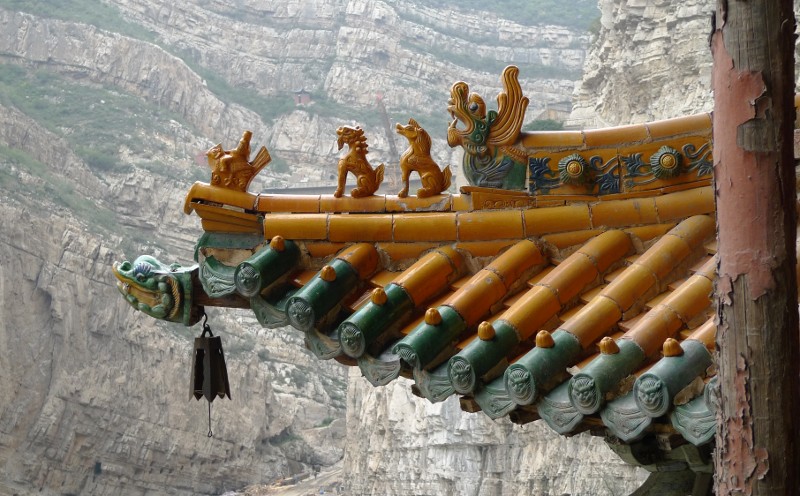
One of three non-industrial reasons to stop in Datong, the Hanging Monastery is truly a fantastical sight.
Who would live on a cliff face like this?
Monks it would seem and not only those of a particular type as the Hanging Monastery has Buddhist, Taoist and Confucian elements.
The nearby trickle with pretensions of being a river must become a raging torrent with spring snow melt because some serious concrete channels had been constructed and our guide told us that the Monastery had been washed away a couple of times and rebuilt slightly higher up the cliff face.
Despite the place crawling with tourists, a well thought out one-way loop of a route enabled frustration free touring and appreciation of the vertiginous positioning.
Despite the simple wooden construction and sheer drops beside most walkways, the building felt stable, with a magical quality to the way it clung to the cliff.
Experiencing that stability while walking around it made the location seems slightly less ridiculous than when viewed from the valley floor.
One of the best preserved shrines.
Ceiling art, accompanied by an entirely necessary, but unnecessarily conspicuous smoke detector.
Is this really necessary!? Whether it should be there or not is debatable, but that it should be so conspicuous?

Wednesday, 6 April 2011

Mini Potala Palace

2009 09 15 – Day 81 – Chengde

Putuo Zongcheng Temple, modelled on the Potala Palace in Lhasa, is a definite highlight of Chengde.
The view from the car park is impressive:
but not quite as impressive as this view.

The top of a gateway

The Imperial way to ascend. Sadly there were no porters.

I can't help but feel a little uncomfortable looking at this sculpture. It seems to me as if the elephant's forelimbs are broken.... and yet an image search for 'elephant lying down' reveals that the sculptor wasn't entirely wayward.

Approaching the temple involves a stroll uphill through pleasant gardens,
followed by a steep climb up stone stairs

Inside is much more human than the formidable sheer outer walls would have you believe
and worth exploring.
This exposed pillar paintwork tells you everything you need to know about the strength of the sun here, standing in it too long and why there are so few windows in the building.

Imperial stage for Imperial performances... presumably for, rather than by the Emperor.

Up on the roof there's little chance to escape the heat of the sun,
so I didn't stay up there long - completing a short lap and briefly enjoying the views -
like this one, across another of the Eight Outer Temples of Chengde to Sledgehammer Peak, before descending to join my little tour group.

Can't See the Wood for the Musicians

2009 09 15 – Day 81 – Chengde

After the underwhelming Hill Temple, I wasn't expecting a lot from Puning Temple.

I think they were preparing for the upcoming 60th anniversary of the founding of the People's Republic of China celebrations, but I'm not sure.

The main temple building, in front of which some musicians were playing:
I was quite interested in some of their instruments and the sounds they were making, but couldn't stand around all day and so moved on to explore elsewhere.
I'd imagine whatever is at the bottom of that pile is pretty secure!
But it wasn't just that pile, there were padlocks all over the place on railings, lanterns and anything that seemed a permanent fixture in the gardens behind the temple.

To leave the temple complex, tourists are herded along a mock ancient street lined with shops overflowing with everything a tourist could want
I wasn't too put off by 'tourist street' until costumed children appeared to perform short acrobatic feats before requesting money.
I hurried on through.

It wasn't until I was on the train to my next destination that I realised I'd missed something. Scanning through the Lonely Planet to read some history that I might have missed due to my guide speaking Chinese, I was confused by not being able to find the write up of this temple. Digging out my ticket confirmed that it was Puning Temple, but the Lonely Planet guide said that Puning Temple contained the world's largest wooden sculpture! Where the hell was that then!? How could I have missed it!? I raced through the pictures on my camera in disbelief.
Ah. That's where it was!
Distracted by the musicians, tourists milling in the doorways, and a little pressed for time, I'd elected not to jostle for a view inside.
That'll learn me! Always know what you're going to see!
Ah well. Maybe I'll see it next time I'm in town! :P

Monday, 31 January 2011

Yonghegong - Lama Temple

2009 09 05 – Day 71 – Beijing

Thanks to my Dad's love for silliness and wordplay, I can't help but associate the word 'Lama' with this Ogden Nash ode to the llama:

  The one-L lama,
  He's a priest.
  The two-L llama,
  He's a beast.
  And I would bet
  A silk pajama
  There isn't any
  Three-L lllama.
 
Of course the above poem has absolutely nothing to do with the Buddhist Lama Temple in Beijing – Yonghegong.
It seemed to be the done thing to offer incense at the temple and so I'd bought the second cheapest pack from one of the multitude of stalls on the street outside the front gate. However, once inside, I didn't feel the inclination to make such an offering. Watching those who lit their sticks of incense, raised them to their forehead and bowed three times before planting the sticks in the large sand-filled iron troughs, the thought of mimicking that spiritual gesture made me feel like an imposter. Thankfully there was no real pressure to offer incense, so I didn't, but that did leave me with a pack of incense in my bag for a week!
I love these Buddhist gods with a million limbs! On the left is The Great Dignity and Virtue (Yamantaka) and on the right is Kala-chakravajra (both 18th Century gilt copper).