Showing posts with label history. Show all posts

Friday, 9 September 2011

Korean War Museum

2009 09 17 – Day 83 – Dandong

One of the few 'sights' of Dandong, this Korean War museum has an impressive title that simultaneously demonstrates both the descriptive nature of Chinese and the 'editorial line' of the curators. It's official name translates as:
'The Museum to Commemorate the War to Resist American Aggression and Aid Korea.'
A 53-meter cenotaph commemorates the 1953 cessation of conflict and the 115,000-400,000 (depending on who's counting) Chinese conscripts and volunteers who died executing Mao's "human wave" strategy, designed to overwhelm superior firepower and weaponry with sheer numbers.
For a small entrance fee you can climb the inside of the cenotaph for grand views of the arrayed hardware of war;
and, were it not for the smog, I'm sure there'd be spectacular views across the city and into North Korea, but sadly I couldn't see much further than the main museum buildings less than 100m away.
More hardware welcomes visitors,
followed by Mao Zedong and Kim Il Sung, the first among equals from the Chinese and North Korean sides, celebrating their hard won 'victory' with their comrades.
Flanking the statue are two short, two-storey, introductory texts: a "Joint Declaration of Democratic Parties in China" announcing the US/allied intention to "not only destroy [North Korea], but also annex Korea, invade China, rule Asia, even conquer the whole world." (4th November 1950); and an "Order of the Formation of the Chinese People Volunteers" declaring the righteous nature of their cause assisting their Korean neighbours in resisting the imperial aggressors (8th October 1950).

Somewhat surprisingly, the museum entrance was free which was a welcome change from my Chinese tourism experience so far and especially generous considering the scale and scope of he exhibition.
The range of artefacts on display was impressive and well presented including:
Chinese weaponry;
and standard kit;
US kit;

dynamic summaries of offensives and troop movements;

a mini reconstruction of a North Korean/Chinese tunnel base;
propaganda espousing the pointlessness of war and the joys home, dropped to break US/allied moral, and poignant letters home from GIs;
An informative section on the nascent Chinese airforce and an impressively arranged, painted and lit 360 degree diorama of a battlefield;
it was actually quite difficult to identify the join between three-dimensional models and painted backdrop.
Exiting the grounds of the museum gave you a closer encounter with the field of hardware.

Despite its impressive array of artefacts, information boards and well laid out displays, the museum was somehow a frustrating blend of the positive and negative possibilities of museums. As far as a museums responsibility to deliver a sense of how things were at a time in history, it was a huge success, with ample artefacts and plentiful pictures well edited, arranged and curated. However, as far as a museum might be expected to deliver an objective reflection on past events, the politics dictating the editorial of the information boards was perhaps more evident in what was not said rather than what was. For the most part, the boards offered an exhaustive catalogue of events, delivered without much more imagination than a list of names, dates, times and quantities (or whichever appropriate combination). It took me until I was about half way round to realise that of all the many information boards I'd read, not one had mentioned a US/Allied victory and while there were plentiful reference to (dubiously large) numbers of enemy killed or captured at each battlefield, there was not even one mention of a single Chinese or North Korean casualty or strategic loss. Campaigns were always presented as victorious, with no explanation as to why there were multiple 'successful' campaigns, at different times, for the same territory, no mention of the (presumably) enforced retreat between the different 'successful' offensives.
Throughout, the US/S.Korean/Allied forces are labelled as imperialist aggressors and oppressors while the Chinese/North Koreans are labelled as valiant volunteers and courageous defenders of freedom.
The walk back to my hotel gave me plenty of time to reflect on what effect that kind of one-sided account would have on Chinese visitors to the museum.... no wonder it was free entry!

Wednesday, 6 April 2011

Mini Potala Palace

2009 09 15 – Day 81 – Chengde

Putuo Zongcheng Temple, modelled on the Potala Palace in Lhasa, is a definite highlight of Chengde.
The view from the car park is impressive:
but not quite as impressive as this view.

The top of a gateway

The Imperial way to ascend. Sadly there were no porters.

I can't help but feel a little uncomfortable looking at this sculpture. It seems to me as if the elephant's forelimbs are broken.... and yet an image search for 'elephant lying down' reveals that the sculptor wasn't entirely wayward.

Approaching the temple involves a stroll uphill through pleasant gardens,
followed by a steep climb up stone stairs

Inside is much more human than the formidable sheer outer walls would have you believe
and worth exploring.
This exposed pillar paintwork tells you everything you need to know about the strength of the sun here, standing in it too long and why there are so few windows in the building.

Imperial stage for Imperial performances... presumably for, rather than by the Emperor.

Up on the roof there's little chance to escape the heat of the sun,
so I didn't stay up there long - completing a short lap and briefly enjoying the views -
like this one, across another of the Eight Outer Temples of Chengde to Sledgehammer Peak, before descending to join my little tour group.

Can't See the Wood for the Musicians

2009 09 15 – Day 81 – Chengde

After the underwhelming Hill Temple, I wasn't expecting a lot from Puning Temple.

I think they were preparing for the upcoming 60th anniversary of the founding of the People's Republic of China celebrations, but I'm not sure.

The main temple building, in front of which some musicians were playing:
I was quite interested in some of their instruments and the sounds they were making, but couldn't stand around all day and so moved on to explore elsewhere.
I'd imagine whatever is at the bottom of that pile is pretty secure!
But it wasn't just that pile, there were padlocks all over the place on railings, lanterns and anything that seemed a permanent fixture in the gardens behind the temple.

To leave the temple complex, tourists are herded along a mock ancient street lined with shops overflowing with everything a tourist could want
I wasn't too put off by 'tourist street' until costumed children appeared to perform short acrobatic feats before requesting money.
I hurried on through.

It wasn't until I was on the train to my next destination that I realised I'd missed something. Scanning through the Lonely Planet to read some history that I might have missed due to my guide speaking Chinese, I was confused by not being able to find the write up of this temple. Digging out my ticket confirmed that it was Puning Temple, but the Lonely Planet guide said that Puning Temple contained the world's largest wooden sculpture! Where the hell was that then!? How could I have missed it!? I raced through the pictures on my camera in disbelief.
Ah. That's where it was!
Distracted by the musicians, tourists milling in the doorways, and a little pressed for time, I'd elected not to jostle for a view inside.
That'll learn me! Always know what you're going to see!
Ah well. Maybe I'll see it next time I'm in town! :P

Sunday, 20 March 2011

Culture Museum

2009 09 14 – Day 80 – Shanhaiguan

Although I wasn't particularly looking for it, the tourist shepherds of Shanhaiguan ensured I visited the small but enjoyable Culture Museum.
A pleasure to see some genuinely old artifacts in this 'renovated' town.
I really liked the look of these ornately carved raised beds, though I imagine I'd need a larger size.

I really like this sculpture.
There's something ugly about the proportions and yet its simultaneously beautiful from its curves and flow of forms.
Wonderful! :)

I See No Sea

2009 09 14 – Day 80 – Shanhaiguan

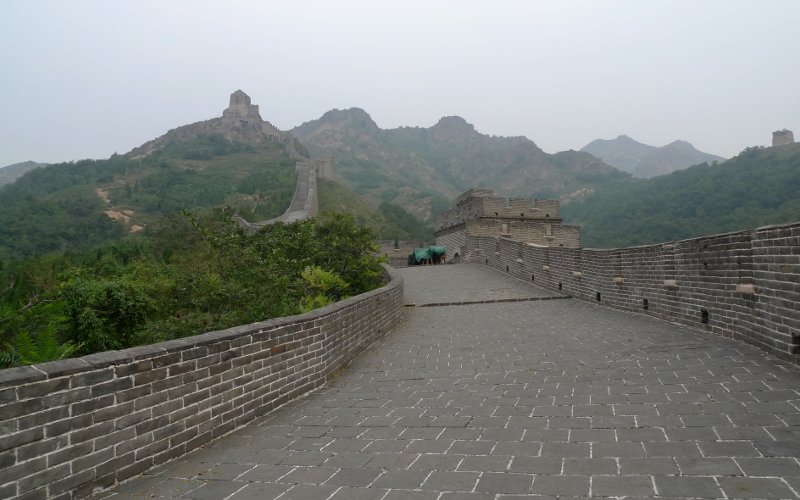
I rose early with ambition to climb the nearby section of The Great Wall, hopeful of a grand view over Shanhaiguan and out to sea, before checking out some of the touristy stuff in town and a visit to the shore before heading on to my next destination at the end of the afternoon. Seemed feasible.
A short but wobbly ride in a three wheel red Reliant Robbin wannabe got me to the Great Wall park before anyone else, including, it seemed, the park staff! At first, I was being told by my driver and others hanging around outside, that it wasn't open yet and I couldn't enter, but the gates were wide open and my persistence eventually revealed that actually it was just the chairlift that wasn't operational yet and if I was crazy enough to walk up, then of course I could enter! Which I did. At that point, of course some staff did materialise from round some corner or other to make sure I paid my entrance fee.
Didn't look too bad a climb.
Before I knew it I had my own personal Great Wall climbing coach:
Waddling up to my side and then bouncing on ahead, then pausing to grin back at me – come on Martin! It's enthusiasm was infectious. I'm not quite sure how it managed to bound up stairs twice the height of it's legs, but it was inspirational!

As the climb got progressively steeper I started to worry for my little chum, who now needed more regular breaks, lungs clearly working overtime, visibly heaving. But the panting pooch would not give it up... Until the onward path was a ladder into a tower:
Or so I thought! Down the other side of the tower and re-joining the wall, there was pooch, waiting for me! Clearly the little bounder had been this way before.

Entering the wooded crest of the hill I began to encounter beasties:

Spiders with leg spans of about 15cm, and possibly the hairiest caterpillar ever:

Good thing the temple at the peak had some guardians:

Over the other side, the scenery was quite different and the sun began to power its way through the smog, giving me hope of a fine view:

But time wore on and sun and smog seemed to reach a stalemate and I had to return to the town if I wanted to fit everything in.
By the time I was most of the way down, the smog had won and, though I had a reasonable view of the plain between mountains and sea that Shanhaiguan protected, I would not have the view to the sea that I'd hoped for.

But a wedding or two is not a bad substitute!
One of the two couples enjoying a photoshoot with the greatest of walls on their special day.

Back in town, visiting the First Pass Under Heaven, I got a consolation prize:
At last! A view of the sea!
Ok, not quite what I'd hoped for, but a fine artistic depiction of the strategic significance of Shanhaiguan and its position between mountains and sea.